
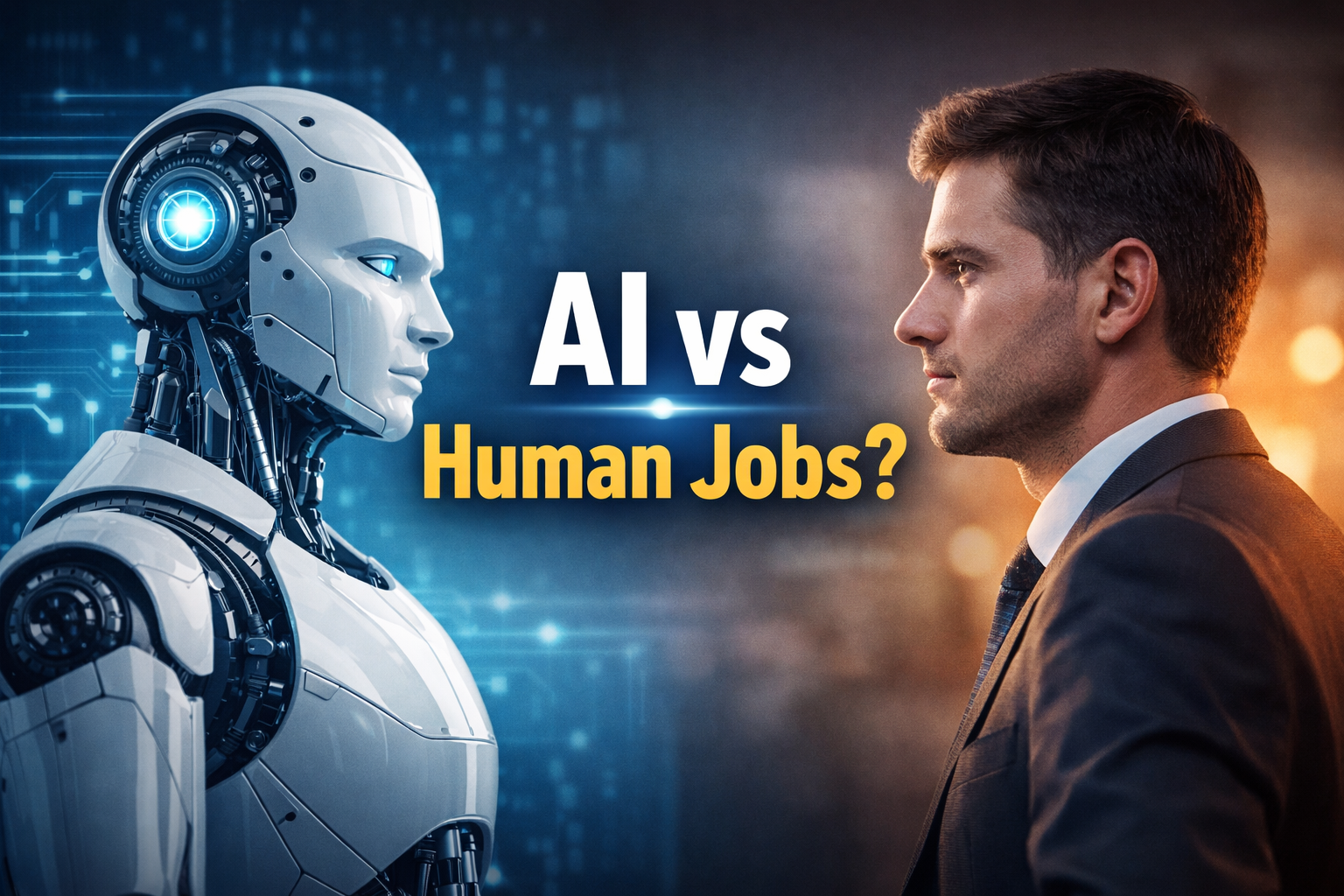
Artificial Intelligence (AI) is transforming the global workforce faster than any technology in history. From automated chatbots to self-driving cars, machines are now performing tasks once handled exclusively by humans. This rapid progress raises an important question:
Will AI replace human jobs, or will humans remain irreplaceable?
The debate around AI vs human jobs has become one of the most searched topics worldwide. As companies adopt automation and AI-powered tools, the future of work is evolving rapidly. But the reality is more complex than simply “AI replacing humans.”
Let’s explore how AI is changing employment and who will ultimately win in the battle between artificial intelligence and human workers.
The Rise of Artificial Intelligence in the Workplace
Artificial intelligence has moved from research labs to everyday business operations. Companies now use AI for:
- Customer support chatbots
- Automated marketing campaigns
- Data analysis and forecasting
- Content generation
- Fraud detection
- Medical diagnosis
According to global research, AI could contribute up to $15.7 trillion to the world economy by 2030, highlighting how powerful this technology has become.
Businesses adopt AI primarily because it can:
- Work 24/7 without fatigue
- Process massive amounts of data
- Reduce operational costs
- Improve efficiency
This rapid adoption is why many experts predict the future of work will involve a combination of AI and human collaboration.
AI Job Replacement Statistics
The fear that AI will replace human jobs is not entirely unfounded. Several studies reveal the growing impact of automation on employment.
Some key statistics include:
- AI and automation could displace 92 million jobs globally by 2030.
- Around 14% of workers have already experienced job displacement due to AI automation.
- AI may replace the equivalent of 300 million full-time jobs worldwide in the long term.
However, the story doesn’t end there.
Experts also predict that AI will create more jobs than it destroys. Reports estimate that AI could eliminate 85 million jobs but create 97 million new roles, resulting in a net increase in employment.
This means the real question is not whether AI will replace humans, but how jobs will change.
Jobs Most Likely to Be Replaced by AI
AI excels at performing repetitive, predictable, and data-driven tasks. Jobs that rely heavily on routine work are the most vulnerable to automation.
Some examples include:
1. Data Entry Jobs
AI can process and organize large datasets much faster than humans.
2. Customer Service Agents
AI chatbots and voice assistants are already handling millions of customer queries.
3. Basic Content Writing
AI tools can generate basic articles, product descriptions, and reports.
4. Manufacturing Jobs
Robots and automated machines now handle assembly lines and packaging.
5. Bookkeeping and Accounting
AI can automate financial calculations and transaction analysis.
These roles are being replaced because machines perform repetitive tasks with higher accuracy and lower cost.
Jobs That AI Cannot Replace
Despite the growth of automation, many professions remain difficult for AI to replace.
These jobs require uniquely human skills such as creativity, empathy, leadership, and emotional intelligence.
Examples include:
Healthcare Professionals
Doctors, nurses, and therapists rely on empathy and human connection.
Creative Professionals
Artists, filmmakers, designers, and writers depend on imagination.
Teachers and Educators
Education involves emotional understanding and human interaction.
Psychologists and Counselors
Mental health support requires emotional intelligence and trust.
Strategic Leaders
Entrepreneurs and executives rely on complex decision-making.
These roles rely on skills that machines struggle to replicate.
AI vs Human Intelligence
To understand the future of work, it is important to compare AI intelligence and human intelligence.
| Factor | Artificial Intelligence | Humans |
|---|---|---|
| Speed | Extremely fast | Slower |
| Creativity | Limited | Highly creative |
| Emotional Intelligence | None | Strong |
| Decision Making | Data-driven | Intuitive |
| Adaptability | Limited | Highly adaptable |
AI is powerful in data analysis and automation, but humans dominate in creativity, empathy, and innovation.
The future will likely involve human-AI collaboration instead of competition.
The Future of Work: Humans + AI Collaboration
Rather than replacing humans entirely, AI is more likely to augment human capabilities.
Examples of this collaboration include:
- Doctors using AI to detect diseases earlier
- Marketers using AI to analyze consumer behavior
- Writers using AI for research and content ideas
- Engineers using AI for predictive design
Companies that combine human creativity with AI efficiency will have the biggest competitive advantage.
Skills Needed to Survive the AI Era
To stay relevant in the AI-driven job market, workers must develop future-proof skills.
Important skills include:
Digital Skills
Understanding AI tools and technology.
Critical Thinking
Analyzing complex problems beyond algorithmic logic.
Creativity
Developing innovative ideas that machines cannot replicate.
Emotional Intelligence
Building relationships and understanding human emotions.
Continuous Learning
Adapting to changing technology.
Workers who embrace AI instead of fearing it will benefit the most.
Final Verdict: Who Wins — AI or Humans?
So who wins the battle between AI vs human jobs?
The answer is simple:
Neither.
The real winner will be those who learn to work alongside AI.
Artificial intelligence will automate repetitive tasks, but humans will remain essential for creativity, strategy, and emotional intelligence.
In the future workplace, success will belong to people who combine human intelligence with AI technology.
Instead of competing with machines, we should focus on becoming smarter with them.
Conclusion
Artificial intelligence is reshaping the global job market, but it is not the end of human employment. While AI will replace certain repetitive roles, it will also create new opportunities in emerging industries.
The future of work will be defined not by AI vs humans, but by AI working with humans.
Those who adapt, learn new skills, and embrace technology will thrive in the new digital economy.
One thought on “AI vs Human Jobs: Who Will Win the Future of Work in 2026 and Beyond?”